Projectively realized altermagnetism in an exactly solvable model
In recent years, "altermagnetism" has emerged as a new notion to describe ordered states of local magnetic moments with a vanishing net magnetization but broken time-reversal symmetry (resulting, for example, in spin-split band structures even in the absence of any (relativistic) spin-orbit coupling). The crucial idea is that in the magnetic state, there is a combination of spin rotations and point group symmetry operations (for example, a spin rotation by 180º and a C4 lattice rotation) which remains a good symmetry and protects the system from developing a finite magnetization.
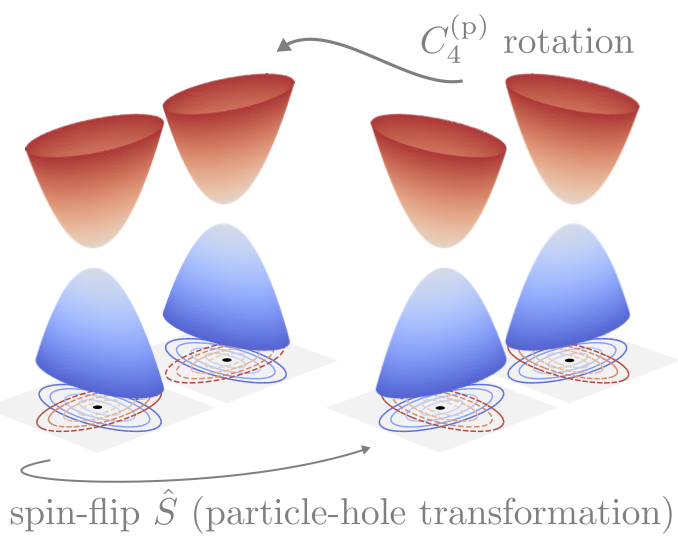
In our work [1], we extend the notion of altermagnetism to quantum magnets which have no classical analogue: in these states, strong quantum fluctuations can lead to the fractionalization of spins into partons which have unusual quantum numbers and couple to an emergent gauge field. We were able to construct exactly solvable models which realize "fractionalized altermagnetism (AM*)". In these states, the fractionalized degrees of freedom can still display spin splittings as in conventional altermagnetic systems – however, due to the coupling of an emergent gauge field, these spin splittings can be encoded onto the parton bandstructure in a highly non-trivial way! This can be determined by analyzing operations within the projective symmetry group (PSG) of the fractionalized state.
We further discuss possible observable signatures of AM* states, and in particular nonlinear thermal/spin transport probes.
- A. Neehus, A. Rosch, J. Knolle, and U. F. P. Seifert,
> Phys. Rev. Lett. 135, 256504 (2025)