Advanced Seminar (Oberseminar)
> Prof. Simon Trebst and > Jun.-Prof. Urban Seifert
Fri 10:15-11:45
seminar room E0.01 | Institute for Theoretical Physics (new building)
The seminar will start on Friday October 23rd, 2026.
Gauge theories in condensed matter and quantum information
Description
This seminar uses gauge theory as a unifying principle connecting condensed matter physics and quantum information. We will study how local constraints lead to emergent gauge fields which can describe non-trivial phases and excitations of condensed matter systems, as well as the dynamics of quantum circuits as realized by modern-day Noisy Intermediate Scale Quantum (NISQ) devices.
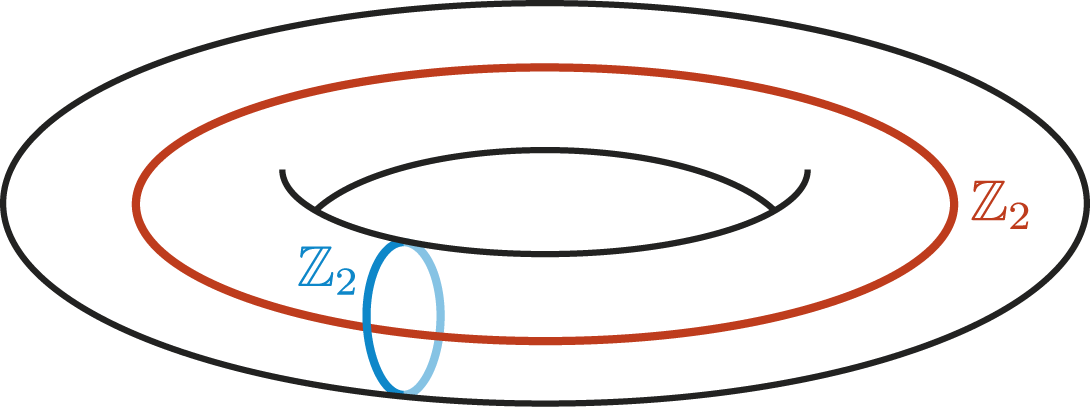
The toric code is one particularly famous example: its stabilizer constraints can be understood as a lattice gauge theory and demonstrates how topological order and long-range entanglement can emerge in a system of interacting spin-1/2 degrees of freedom. From a different perspective, precisely the same features provide protected ways to store and manipulate quantum information.
Throughout the seminar, we will emphasize gauge theory as a common language. We will consider both fundamental aspects, examining the stability of emergent gauge theories, as well as modern-day applications.
List of topics
- Elasticity and its dual gauge-theory description
- Kogut’s approach to lattice gauge theory
- The toric code
- Chern–Simons theory and the Jones polynomial
- The Higgs mechanism
- Quantum spin liquids
- Monopoles and confinement in (2+1)-dimensional U(1) gauge theory
- The U(1) Dirac spin liquid and its stability
- Long-range entanglement from short-range-entangled states
- Quantum simulations of gauge theories
- Gauge theory of measurement-based quantum computation